A Cascade of Missed Triggers
8 marzo 2025
During the course of Pro Tour: Yokohama, we made a policy decision. Pro Tours are exciting for players, whether competing or watching from home, and for judges as well. The highest-stakes events put our policies to the test, expose edge cases, and drive meaningful improvements to our documentation. This weekend has led to one such change.
What Happened
Over the course of the first few rounds of Pro Tour: Yokohama, the event judge leadership noticed that two different rulings were given by judges in similar situations involving Arakni, Marionette. While Flesh and Blood policy allows for great freedom to judges when applying their rulings in order to fit them to the context of the specific games they have to fix, consistency, especially at high level, is something we strive for, as it allows players to better anticipate the results of a given mistake, and ensure the game is kept fair and free of conscious or unconscious biases, especially in high stakes environments.
The event leadership then interviewed the judges responsible for these rulings, identified the reasons and philosophy behind them and how they clashed, and reached an agreement on what should be the ruling most fitting our documents.
What Changed
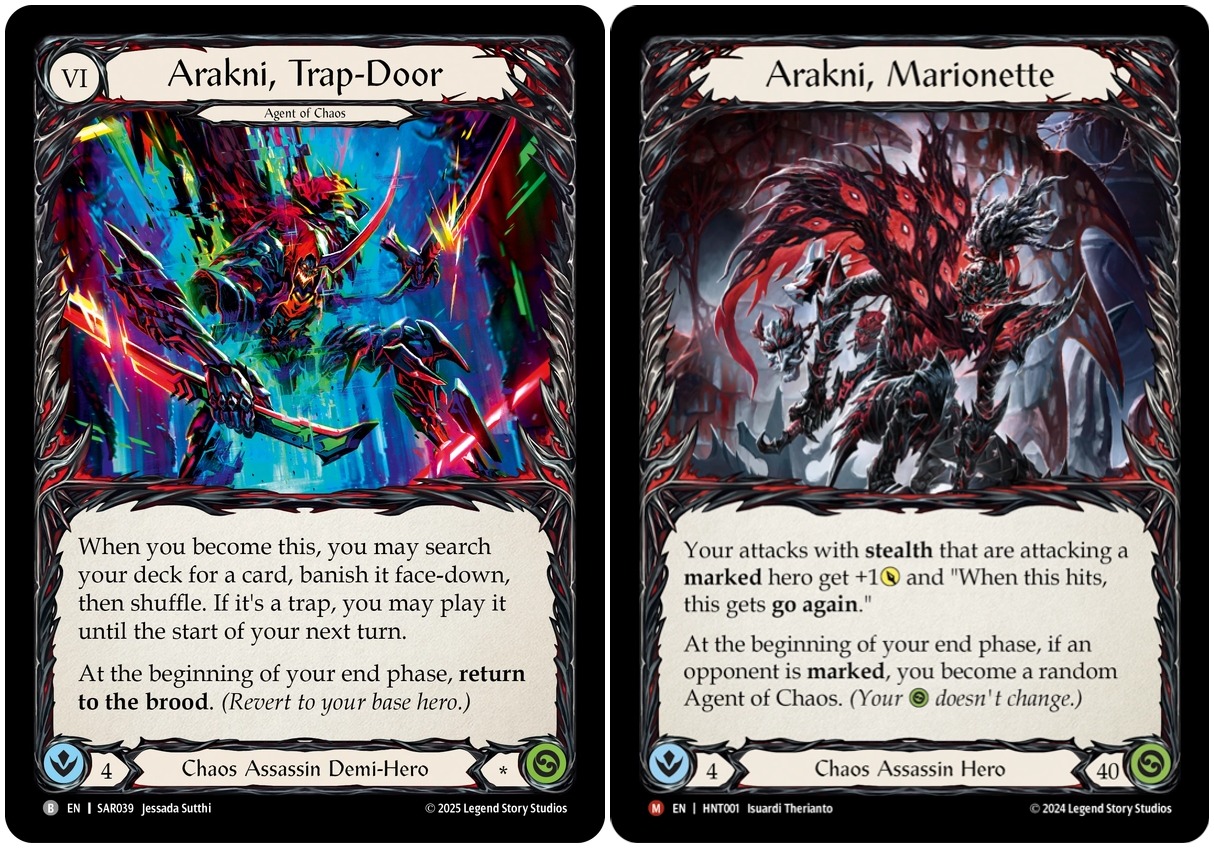
If a player unintentionally misses their Arakni, Marionette / Arakni, Web of Deceit trigger and it is noticed soon after, this is a 2.3 Missed Trigger infraction. We apply the following fix: “If either player has made additional actions after the infraction, apply a partial fix as if the triggered effect has been resolved at the correct point in the game.” And the following upgrade: “If the player would have gained an advantage from missing the trigger, and the triggered effect was ultimately created by the player (and not the opponent), upgrade to a Warning.”
Critically, if the player then rolls a 6 and becomes Arakni, Trap-Door, Trap-Door’s triggered ability is considered missed, meaning the player does not search their deck for a trap: we apply the following clause of 2.3 Missed Trigger: “If the only part of a triggered effect that would have an impact on the game is optional and it is not acknowledged, it is assumed that the controlling player decided to not generate that effect and it is not considered an infraction.”
This may differ from rulings you have made or witnessed, advice you have received, at previous events, including rulings made earlier at the Pro Tour. It also differs from an announcement we made more than twelve months ago. The ruling above is the conclusion reached through careful discussion between Judges of Rathe program leadership, the Policy Team, and LSS’s Rules and Policy Manager, and represents the most coherent application of our rules and policies, best fulfilling the three pillars of judging: education, equity, and mission.
Why We Changed It
The reasoning requires understanding a concept not explicitly laid out in the rules, but important to apply correctly: the cascading of Missed Triggers. In short, missing a trigger automatically means missing any triggers that would have been generated by events resulting from that missed trigger if it had been resolved at the proper time.
The error being made was to rule Marionette’s trigger as missed, while treating Trap-Door’s trigger as something the player had not yet had the opportunity to miss, and applying an incorrect fix as a result. The correct approach is to apply 2.3 Missed Trigger independently to each trigger in the chain: fix the first missed trigger (through a partial fix if possible, a rewind if not, or no further action if neither is available), then evaluate any subsequent triggers that arise from that fix and apply the appropriate ruling to each in turn.
This concept should be applied to the specific example of Arakni, but is also to similar situations, such as missing Harvest Season’s trigger while you control Verdance, Thorn of the Rose; fixing Harvest Season’s Missed Trigger would make Tyler gain life, but the cascading of Missed Triggers would still make Verdance’s Trigger a Missed one, and we would then apply the “If the only part of a triggered effect that would have an impact on the game is optional and it is not acknowledged, it is assumed that the controlling player decided to not generate that effect and it is not considered an infraction.”, meaning Tyler would gain life, but not deal arcane damage.
The FAB Procedure and Penalty Guide is intentionally not exhaustive, most advanced concepts are omitted to keep it usable. While this concept always existed, because the cascading of Missed Triggers is now directly relevant to one of the most popular Classic Constructed heroes, it will be explicitly addressed in the new version of the PPG.
Why We Changed It Now
The usual process for policy changes is methodical by design: tier 3/4 Head Judges identify friction points, file reports, the Policy Lead opens discussions within the broader HJ group, solutions are proposed and submitted to LSS for review. That process exists to ensure changes are deliberate, well-integrated, and free of unintended consequences.
Pro Tours compress that timeline. The concentration of the program leadership and LSS in a single place allows for real-time, face-to-face discussion, and access to the strongest players in the world allows us to pressure-test proposed rulings against potential undesirable play patterns. Within a few hours, we reached a clear consensus.
By that point, however, we had already issued more than a dozen rulings under the previously dominant understanding, one that, as we now recognize, failed to account for the cascading of Missed Triggers. This was a shared failure across program leadership, not an isolated error, and it reflects precisely how non-obvious this concept is even at the highest levels of the program.
That left us with two non-ideal options:
- Finish the weekend consistently under the prior ruling across all competitive and professional REL events, Day 2 of the Pro Tour, the Calling, and the Showdown, then announce the change on Monday. The benefit: consistency and simplicity of implementation.
- Announce and implement the corrected ruling immediately, accepting that some players might receive different rulings across rounds of the same event. The benefit: we stop knowingly applying a ruling that we have determined to be incorrect.
We chose the second path. We were not comfortable continuing with a suboptimal ruling once a better conclusion had been reached, and we had confidence in both the judges and players present to absorb and relay that information effectively.
We do not expect situations like this to arise regularly. In five years of organized play, I cannot recall a comparable case. Premier events concentrate rules and policy experts who communicate constantly, and the vast majority of rulings are thoroughly understood through thousands of hours of high-level judging. It takes a concept as advanced as the cascading of Missed Triggers to go undetected at this level for this long.
Thank you for reading! You might have additional questions, and if so, please direct them to the appropriate channels of the Judges of Rathe Discord.

Featured image by Jefrey Yonathan.