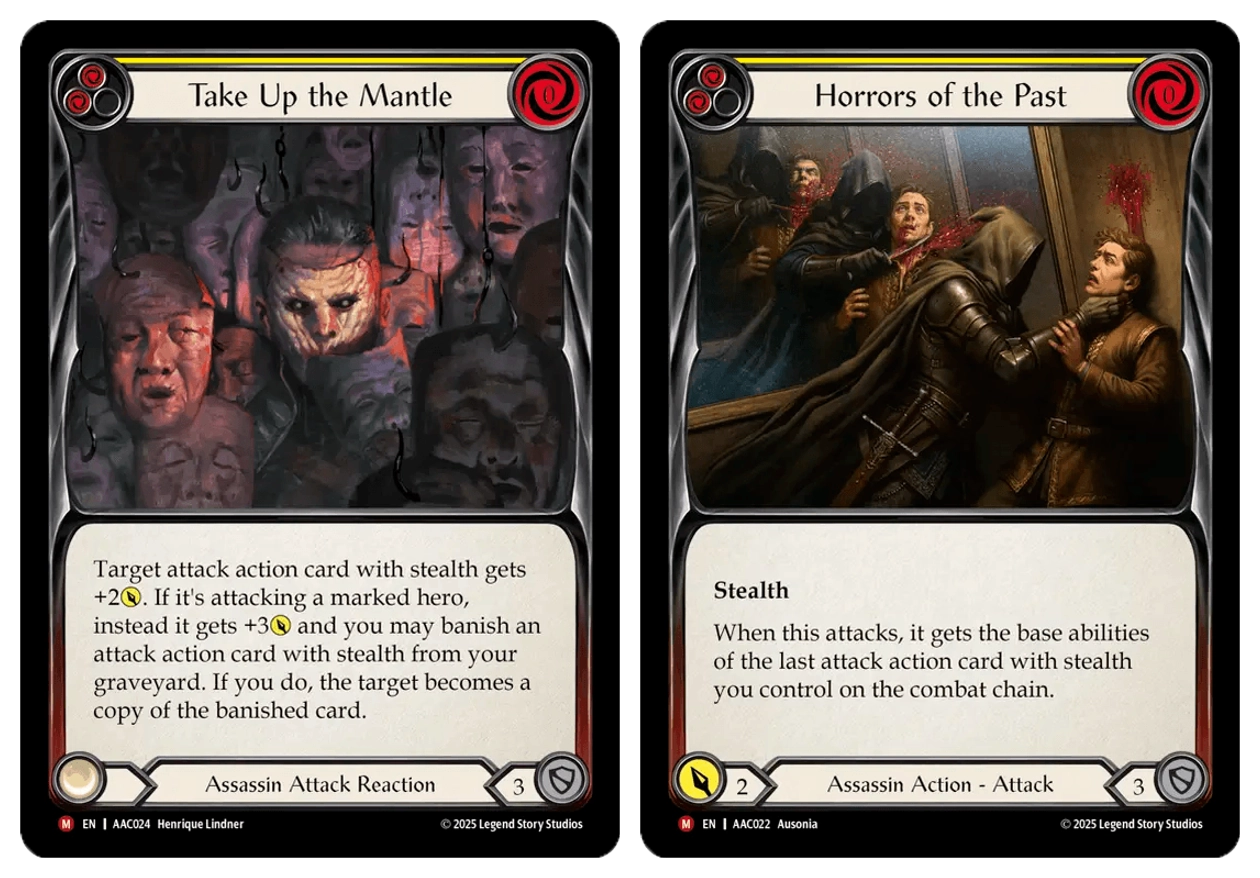
Flesh and Blood is a game that is full of a type of effect known as continuous effects. These effects modify a card or other game object over a period of time, such as adding power, adding abilities to attacks, or turning a card into a copy of another card. While simple on the surface, these effects can quickly become complicated when combined. This article will walk through Flesh and Blood’s stage system to handle multiple continuous effects, and answer the question of how Horrors of the Past interacts with Take Up the Mantle to celebrate the release of Armory Deck: Arakni. There will be many example combat chains to demonstrate the interaction, and in all cases it will be assumed that the opponent is Marked.
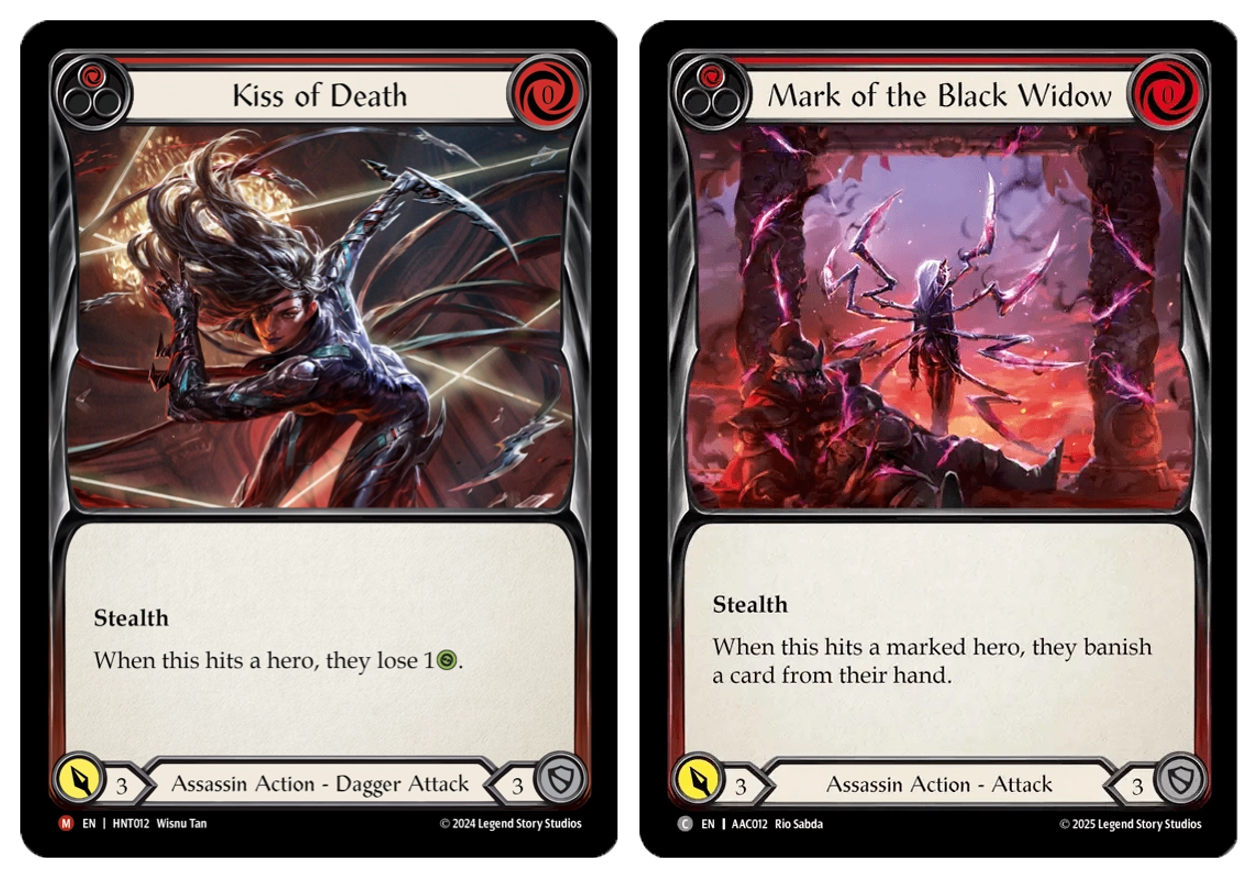
TLDR: If you play a Take Up the Mantle to turn your Horrors of the Past into a copy of a different stealth card, you will end up with a copy of the card from your graveyard that also has the abilities of your last stealth attack. For example, if Tyler attacks Nic with Kiss of Death, then Horrors of the Past, reacting with Take Up the Mantle to copy Mark of the Black Widow, the Horrors of the Past will now be “Mark of the Black Widow” with 2 on-hit abilities: banish a card from Nic’s hand and Nic loses 1 {h}.
To understand this interaction, we first have to talk about stages. Stages are the system that Flesh and Blood uses to ensure consistency when multiple continuous effects are affecting the same game object. The stages are defined in rule 6.3.2, and while they look complicated at first glance, they’re a relatively straightforward process once you get the hang of them. There are additional rules about how to handle multiple effects in the same stage as well as effects moving stages due to dependencies (6.3.2a and 6.3.3 to be specific for anyone who’s interested), but those are outside of the scope of this article.
6.3.2 Stage order is defined by how an effect applies to the object. Effects are grouped into stages and are applied in ascending stage order. If there are two or more effects in the same stage, the effects are applied using substage order.
Stage 1: Effects that modify copyable properties are applied.
Stage 2: Effects that modify or are dependent on the controller are applied.
Stage 3: Effects that modify or are dependent on name, color strip, or text box are applied.
Stage 4: Effects that modify or are dependent on types or subtypes are applied.
Stage 5: Effects that modify or are dependent on supertypes are applied.
Stage 6: Effects that modify or are dependent on abilities are applied.
Stage 7: Effects that modify or are dependent on the base values of numeric properties are applied.
Stage 8: Effects and counters that modify or are dependent on the values of numeric properties are applied.
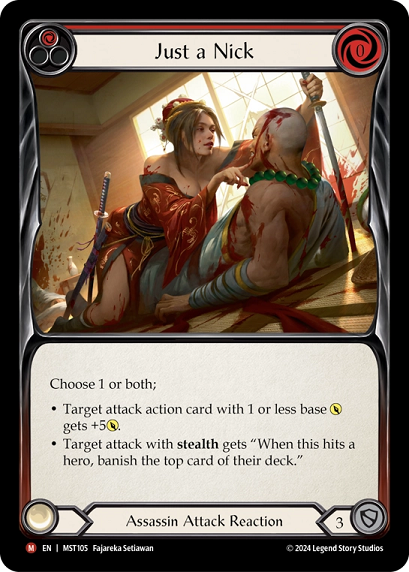
To apply continuous effects, we first create a list of effects to apply. We then go through the stages in order, applying effects as they come up. As an example, let’s take a look at a relatively common example from previous Arakni decks: playing a blue stealth attack, playing Just a Nick, and then using Take Up the Mantle to convert it into a different stealth attack.
In this case, we have 4 continuous effects to apply:
the copy effect from Take Up the Mantle
the +3 {p} from Take Up the Mantle
the +5 {p} from Just a Nick
granting the on-hit trigger from Just a Nick
First we look at Stage 1, which is copy effects. This is what Take Up the Mantle does, so we apply the copy now. We have no further effects in Stages 2-5, so the next effect that we apply is the on-hit trigger in Stage 6. Last but not least, we have nothing in Stage 7 and we apply the +5 {p} and the +3 {p} effects in Stage 8. This leaves us with a card that is a copy of the chosen stealth attack from our graveyard that has an additional on-hit ability and a total of +8 {p}.
This example shows the importance of stages: if we simply applied effects in the order that they happened every time, the Take up the Mantle effects would override the Just a Nick. Coincidentally, this example works the exact same way as Horrors of the Past. Very importantly, Horrors reads “When this attacks, it gets the base abilities of the last attack action card with stealth you control on the combat chain”. The phrase “when this attacks” is important since it means that Horrors doesn’t actually give itself any abilities. Instead, it has an attack trigger and the trigger gives it additional abilities. This is extremely important within this interaction because the trigger and the continuous effect it generates are independent from Horrors itself once they go on the stack: you can override the text of Horrors entirely with a copy effect and the trigger will still be working in the background. This leaves us in almost exactly the same position as before: we have a copy effect from Take Up the Mantle in Stage 1, we have an ability-granting effect from the Horrors of the Past trigger in Stage 6, and we have a +3 {p} effect from Take Up the Mantle in Stage 8. Combining these 3 effects in stage order results in a copy of a stealth attack from your graveyard that now additionally has any abilities from your previous stealth attack and +3 {p}.
Hopefully this interaction and the stage system in general now make more sense. If you have any further questions, please reach out to a local judge or the JudgeHub Discord server. I look forward to seeing all of the interesting combinations that the community can come up with using Horrors of the Past. Remember to keep your opponent Marked, and happy hunting.